In football coverage we are following the American lead, and we are seeing more and more numbers and statistics on data such as the possession, ball recoveries, pass accuracy and shots on target. To support the workflow from data to graphics, Boost Graphics, Gravity Media’s graphics subsidiary, has recently launched a new platform, Next Editorial. “We even let AI think along, which yields great suggestions.”
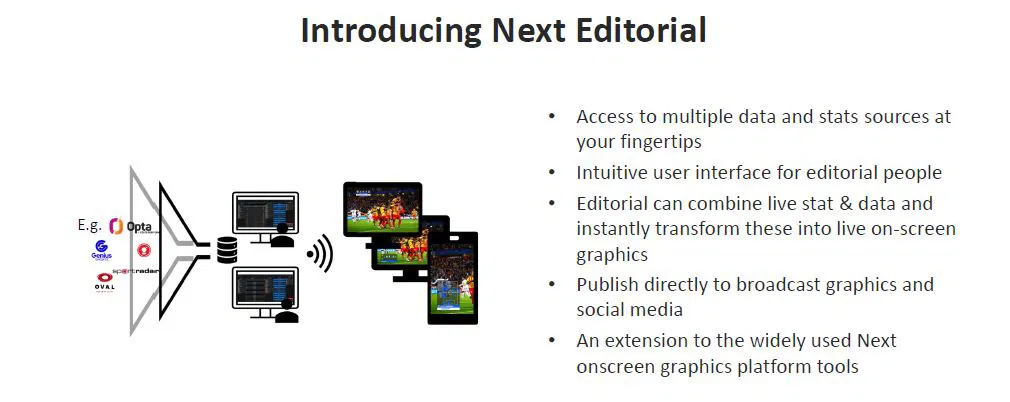
They may not log lace colour just yet, but very little escapes the data collection around sports matches. For every player there are endless statistics, from minutes played to completed passes, distance covered and heat maps for touches. And that is not only for football. Virtually every sports federation has contracts with so called stat providers, who record all kinds of data about matches, teams and players and can deliver them grouped. That does not always arrive in an equally clear way, says Jeroen van Rossum, Director of Operations at Boost International. “The data we want to show as on screen graphics is supplied in different formats. In the current workflow the editor works with the graphics operator to decide which data is interesting. The operator then turns that data into a graphic and puts it live. With Next Editorial the editor not only has a tool that gives insight into the available live data, he can also place that data himself into a graphic template as a preview, which he can make selectable for the operator. The required graphics are produced much faster, which makes a big difference during a live broadcast with time pressure. On top of that we have added an AI feature that can make content suggestions based on the available live data.”
This new feature looks at the data provided by the statistics supplier because this AI tool reads the data and knows the context, the editor can use it like a copilot. Van Rossum: “Look, the system says, these numbers may be relevant for you. It is a recommendation engine. The advantage for the editor is that he can search across multiple live data sources to make combinations between two teams, to name one example, or to display very specific information about a single player. He has it all in a clear interface, with which he can prepare the graphic immediately. He also sees how it will look on screen.” The benefit goes beyond saving time. Because the editor can quickly shape the suggested or self prepared graphics, the operator can focus fully on the match. Van Rossum: “If there is extra information to add, the editor brings it in. That way you build the story together, you have more time for the content. And that leads to better storytelling. Next Editorial is a tool that not only supports the editorial team around a sports match and gives them more insight, it also greatly increases the speed of putting live data on air in the form of graphics.”
Next Editorial was first deployed halfway through last football season in France and has been used by default for every league match in Ligue 1 since this season. The first experiences with the system are very positive, the AI tool was also well received in the initial test phase. The feature is available within the platform, but will be introduced in phases in different countries. “Editors need to learn to work with it. We hope they will experience how pleasant it is to receive smart suggestions. Everyone can do that at their own pace, but I expect they will embrace this quickly. We use AI as support, that is where its value lies.”
To provide the best experiences, we use technologies like cookies to store and/or access device information. Consenting to these technologies will allow us to process data such as browsing behavior or unique IDs on this site. Not consenting or withdrawing consent, may adversely affect certain features and functions. For more information, please see our Privacy Policy.